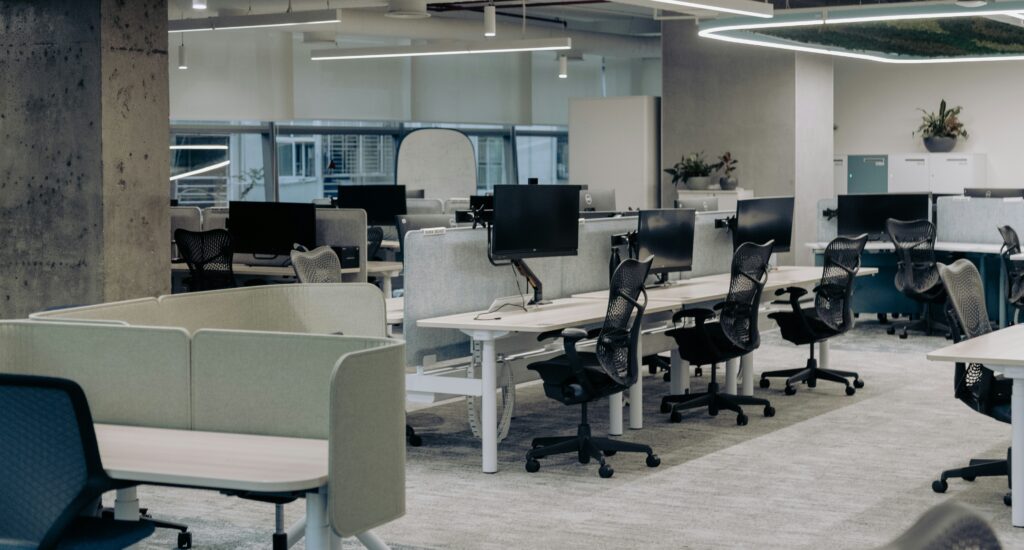
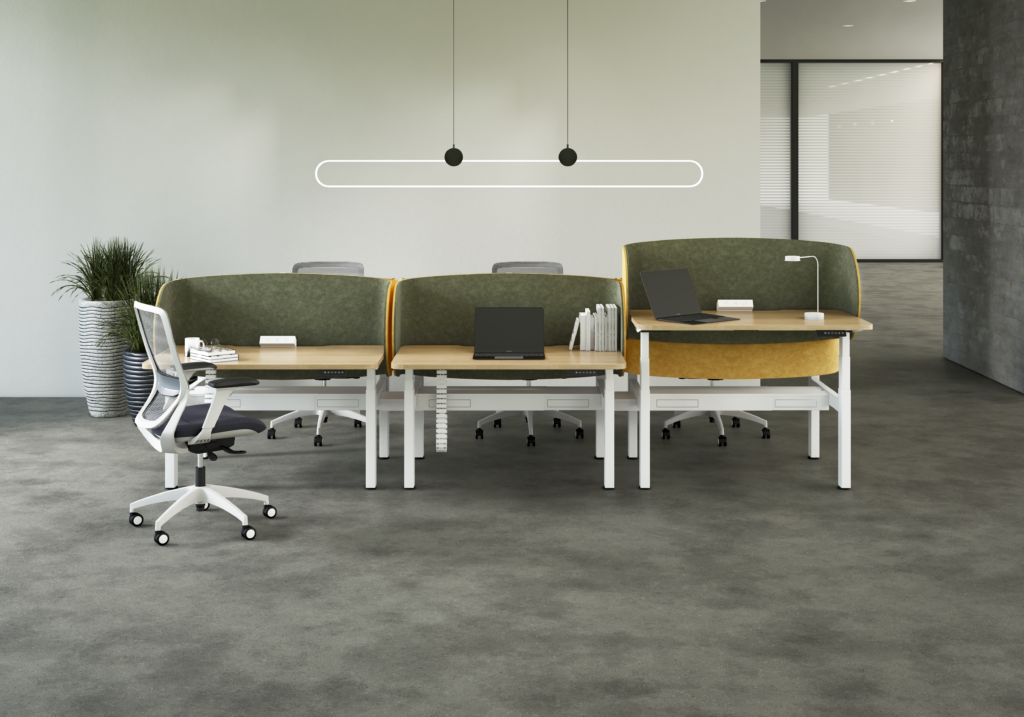
Ten years ago, sit-to-stand desks were a wellness add-on — specified for executive suites and the occasional ergonomic upgrade. In 2026, they are the default. Most new commercial fitouts in Australia specify electric height-adjustable desks across the entire floor, and increasingly across every workspace including hot desks, call centres, and shared bench seating.
The decision has moved from whether to specify sit-to-stand to which sit-to-stand to specify. And the price range — from $400 to $2,500 per desk — reflects a genuine difference in mechanism quality, frame rigidity, motor specification, and warranty. The cheapest end of the market and the premium end are not the same product.
This guide breaks down how to choose well in 2026 — what the price differences actually mean, what to specify for commercial environments, and where the cheap end of the market quietly cuts corners.
Why Sit-to-Stand Has Become the Standard
A few factors have pushed sit-to-stand from optional to expected:
- Workplace health guidelines now recommend movement throughout the day, and sit-to-stand desks are the most cost-effective way to deliver that at scale
- Manufacturer pricing has come down dramatically over the past decade — what cost $2,000+ in 2015 is now achievable at $800
- Tenant expectations have shifted — staff increasingly expect height-adjustable as a baseline workplace standard
- Hot desking and flexible working require desks that adapt to different users at different heights throughout the day
For more on how sit-to-stand specification affects total fitout cost, see our 2026 Australian Office Fitout Cost Guide.
The Price Ranges and What They Actually Mean
| Price band (per desk) | What you’re typically getting |
|---|---|
| $400 – $700 | Entry-level single-motor electric, basic frame, residential or light commercial duty cycle |
| $700 – $1,200 | Dual-motor electric, commercial-grade frame, AFRDI certification or equivalent |
| $1,200 – $1,800 | Premium dual-motor with higher lifting capacity, programmable height presets, sturdier frame, longer warranty |
| $1,800 – $2,500+ | Top-tier brands with anti-collision sensors, integrated cable management, executive finishes, extended warranties |
The difference between $400 and $1,200 isn’t cosmetic. It’s measured in motor lifespan, lifting capacity, frame wobble at full extension, noise level during travel, and warranty coverage. A $400 desk specified for a 200-person open-plan office will start failing within 2–3 years. A $1,200 desk in the same environment is engineered to last 10+.
What to Look for in a Commercial Sit-to-Stand Desk
If you’re specifying for a workplace — not a home office — here are the things that matter.
1. Motor Configuration
Single motor desks use one motor to drive both columns through a connecting shaft. They are cheaper but lift more slowly, have lower weight capacity, and tend to develop column-sync issues over time.
Dual motor desks use one motor per column. They lift faster, more quietly, with higher weight capacity, and maintain alignment over years of use. For commercial environments, always specify dual motor.
2. Lifting Capacity
Commercial desks should rate at 80kg minimum lifting capacity — and ideally 100kg. This isn’t because anyone puts 80kg of files on a desk. It’s because real-world load varies (heavy monitors, monitor arms, drawers, occasional leaning), and a higher-rated motor handles the cumulative wear better.
Avoid anything rated below 70kg for commercial use, regardless of how cheap.
3. Frame Stability at Full Extension
This is where the cheap end of the market reveals itself. At seated height (around 700mm), most desks feel solid. At standing height (1100–1200mm), poorly engineered frames wobble noticeably when you type — and that wobble worsens over years of use.
If you can, test the desk at full standing extension before specifying at scale. Push the desk surface side-to-side. Premium frames barely move. Budget frames flex visibly.
4. Travel Speed and Noise
A good commercial desk travels at around 38mm per second, which means a full transition from seated to standing takes about 10 seconds. Noise is typically 50dB or below at full speed — quiet enough not to disrupt a meeting or call.
Cheap motors are slower and noticeably louder. Over an open-plan office with 50 desks transitioning multiple times per day, the noise difference is significant.
5. Programmable Height Presets
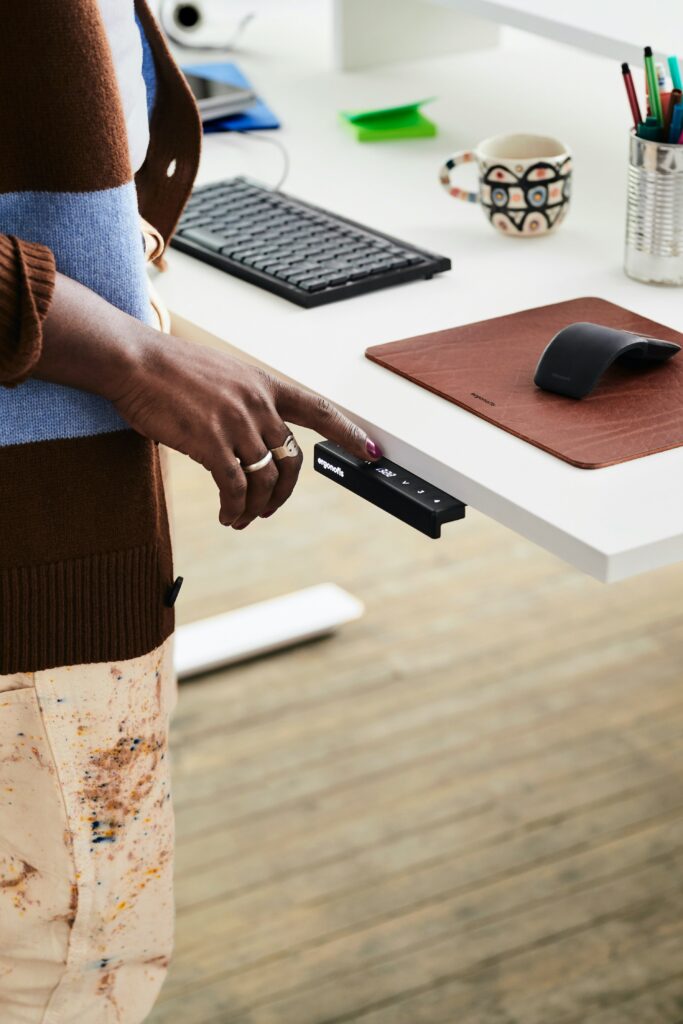
Mid-range and premium desks include a controller with 2–4 programmable height presets. This matters more than it sounds — staff actually use sit-to-stand when the transition is one button press, not a held-down toggle. The presence of presets is one of the strongest predictors of whether a workforce actually uses the standing function after installation.
6. Anti-Collision Sensors
Premium desks include sensors that detect obstructions during travel (a chair, a drawer, a coffee mug) and stop the desk before damage occurs. Not essential, but worth specifying for environments with pedestals, return desks, or high-traffic shared areas.
7. Warranty
| Tier | Typical warranty |
|---|---|
| Entry-level | 2–3 years on frame, 1 year on motor |
| Commercial-grade | 5 years on frame, 3–5 years on motor |
| Premium | 7–10 years on frame, 5–7 years on motor |
For a commercial environment, 5 years minimum on the motor should be the baseline. Anything less suggests the manufacturer doesn’t have confidence in the mechanism.
8. Commercial Certification
In Australia, the relevant benchmark is AFRDI certification — particularly the AFRDI Blue Tick standard for commercial-grade durability. International equivalents include BIFMA (US) and EN527 (Europe). For more on what these certifications mean and why they matter, the Australasian Furnishing Research and Development Institute maintains current standards documentation.
Common Mistakes When Specifying Sit-to-Stand at Scale
When ordering one desk, the stakes are low. When specifying 50 or 200, small decisions compound into large outcomes.
Mistake 1 — Treating it as a commodity purchase. Specifying the cheapest desk that meets the basic spec sheet ignores that real failure happens at the margins: column sync drift, controller failure, motor burnout. The cheap end of the market is cheap for a reason.
Mistake 2 — Skipping the floor load assessment. Sit-to-stand desks weigh more than fixed desks (typically 35–45kg empty). For tenancies with floor load limitations, this matters at scale.
Mistake 3 — Not specifying cable management. A sit-to-stand desk that travels 400mm vertically multiple times per day will pull, snag, and eventually damage poorly routed cables. Specify proper cable trays and risers at procurement, not as an afterthought.
Mistake 4 — Ignoring the user training piece. Sit-to-stand adoption tanks when staff don’t know how to use the presets or aren’t shown how to set their seated and standing heights properly. Include a brief user orientation as part of the install handover.
Mistake 5 — Underestimating delivery and install logistics. Sit-to-stand desks come on large pallets, often via two-person delivery. A 50-desk order requires loading dock access, scheduled delivery windows, and on-site assembly. This is exactly the kind of coordination that benefits from a project-managed approach — see our comparison of buying online vs using a Project Manager for more.
What to Specify for Different Workplace Types
Different environments justify different specs.
Open-plan corporate office (high use, mixed staff)
Dual motor, 100kg capacity, 3+ programmable presets, 5-year motor warranty, AFRDI certified. Mid-range pricing ($900–$1,400 per desk).
Executive suites and meeting rooms
Premium tier with anti-collision sensors, executive finishes, integrated cable management. Higher pricing ($1,500–$2,500), lower volume.
Hot desks and shared workstations
Higher use cycles per day mean longer warranty motors matter more. Specify mid-to-upper range with programmable presets and robust controllers.
Call centres and contact centres
High continuous use, lower transition frequency. Dual motor essential, but lifting capacity less critical. Focus on motor warranty and frame durability.
Small offices and home-office installations
Entry-level to mid-range may be appropriate, depending on use intensity. For occasional use, $600–$900 is reasonable.
In Summary
Sit-to-stand desks have become a default specification in Australian commercial fitouts in 2026, but the gap between the cheap end of the market and the commercial-grade end is significant — and is measured in lifespan, reliability, and user experience.
For most commercial environments, the sensible specification sits in the $900 to $1,400 per desk range: dual motor, 100kg capacity, programmable presets, AFRDI certified, with 5-year motor warranty. Below that band, you save money upfront and pay for it in motor failures and frame wobble within 2–3 years. Above that band, you’re paying for finishes and features that most workplaces don’t need at scale.
The right specification depends on the use case, the budget, and the lifecycle expectation. For projects above a handful of desks, getting the spec right at the start saves significant cost and rework downstream.